Society & Policy
Whose AI Dividend?
AI can create wealth while leaving workers behind. Shirish Nimgaonkar argues that shared ownership, shared gains and trusted autonomy must be deliberate choices.
We Are Living Through the Largest Repricing of Human Labor in History
AI will be the most transformative revolution we experience in our lifetime, and its defining consequence is already here: the largest repricing of human labor in history. This is not a forecast. Wages, roles, and entire career ladders are being revalued in real time.
Every industrial revolution rewards capital first, and the rewards for capital in the AI revolution have already been extraordinary. But prosperity depends on labor too, when gains remain too concentrated, growth slows and unrest follows. The question of our era is not whether AI creates wealth. It is: how do we create enormous wealth AND enduring prosperity?
“Every major leap in human progress begins as a contradiction: fear of what we might lose, and hope for what we might become.”
Four Times in 250 Years, a New Machine Has Rewritten Who Does the Work — and Who Keeps the Reward
Steam and mechanization built the factory. Electricity and the assembly line remade the workplace. Computing and the internet automated the office. Now AI, the fourth revolution does something unprecedented: for the first time, the mind itself is being automated.
The common thread across all four is identical: explosive productivity, painful displacement, and then a fight over who shares the gains.
The Workers Who Smashed the Machines Were Not Against Progress
History’s most misread protest holds the key. The English weavers of the early 1800s smashed the looms only when the profits enriched the owners, not them.
The pattern has repeated ever since. When gains concentrate, displacement dominates, wages stagnate, communities hollow out, resentment turns to unrest. When gains are shared, reinstatement dominates - new industries, new roles, rising wages because labor came along.
“They never feared the machines — they feared being cut out of the gains.”
The Winners Are Already Being Chosen
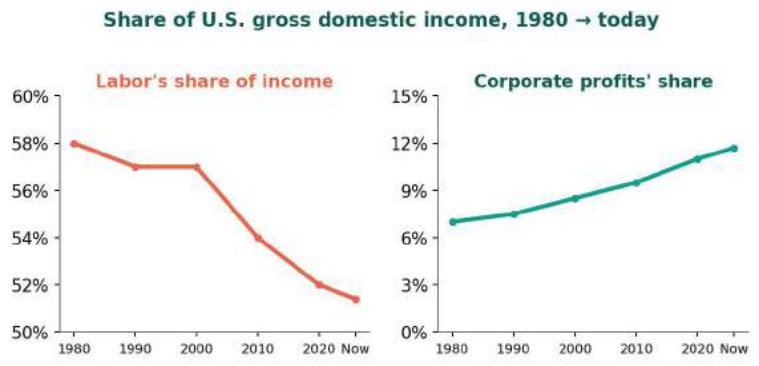
Where are the gains going today? The data is unambiguous: capital is pulling ahead of labor. Labor’s share of U.S. national income has fallen from 58% in 1980 to roughly 51% today, while corporate profits’ share has risen from 7% to 12%. Since 2019 alone, profits have grown 43% against just 3% growth in real hourly wages.
Value Has Decoupled from Headcount
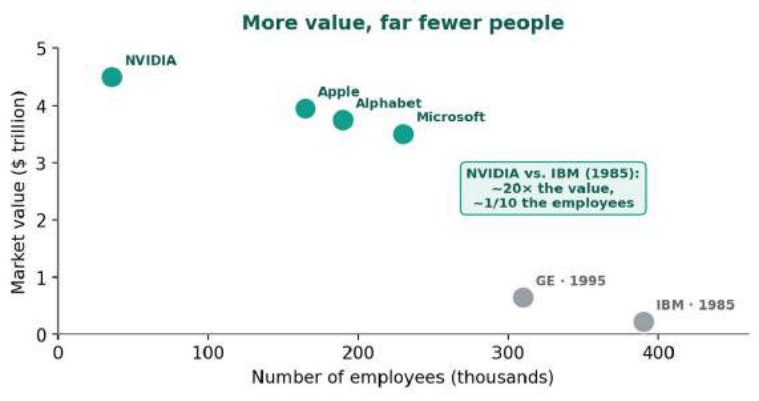
Nvidia, Apple, Alphabet, and Microsoft now generate staggering market value with a fraction of the workforce GE and IBM once required. Nvidia is worth roughly twenty times IBM at its 1985 peak, inflation-adjusted — with about one-tenth the employees. Capital, not headcount, now drives the gains. The open question is whether returns built on so narrow a base can last.
For the First Time, the Machine Has Come for the Mind
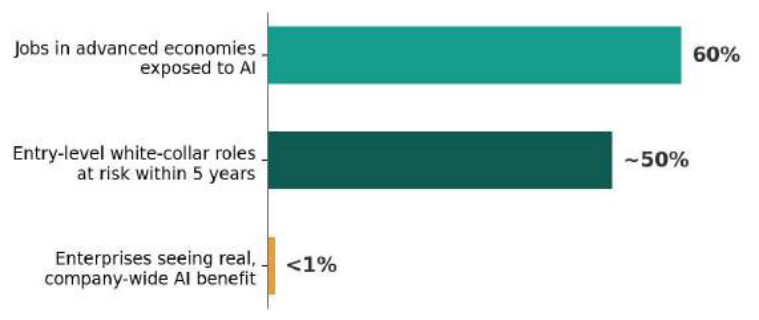
Steam automated the hand; AI automates judgment and it lands first on white-collar, entry-level knowledge work. An estimated 60% of jobs in advanced economies are exposed to AI; roughly half of entry-level white-collar roles are at risk within five years; over 30,000 U.S. layoffs in 2025 cited AI as a factor.
Nations Are Fighting the Same Fight
Coal made Britain; oil redrew the map; the new oil is compute, energy, data, and talent. Producer nations are capturing the gains sovereign-AI spending now tops $100 billion a year while nations that do not own their stack risk becoming digital colonies. For India, with its extraordinary depth of technical talent, this is not a spectator moment.
The Winners Are Already Being Chosen
Walk into any large enterprise and the pain is unmistakable. Boards have mandated AI-driven outcomes, yet fewer than 1% of enterprises deliver them at enterprise-wide scale. Closing that gap is the defining leadership challenge of this decade — and the window is measured in quarters, not years.
Yet fewer than 1% of enterprises see real, company-wide AI benefit. Displacement is arriving faster than the dividend, the most dangerous possible sequencing.
“Whoever controls the inputs controls the era.”
The current operating model cannot keep up. Hybrid work, AI, edge, compliance, and security each add a full dimension of operational load. Fragmented tools produce noise instead of intelligence. Static automations address less than 5% of workflows without human intervention. Headcount has become the scaling bottleneck - reactive, delayed, expensive.
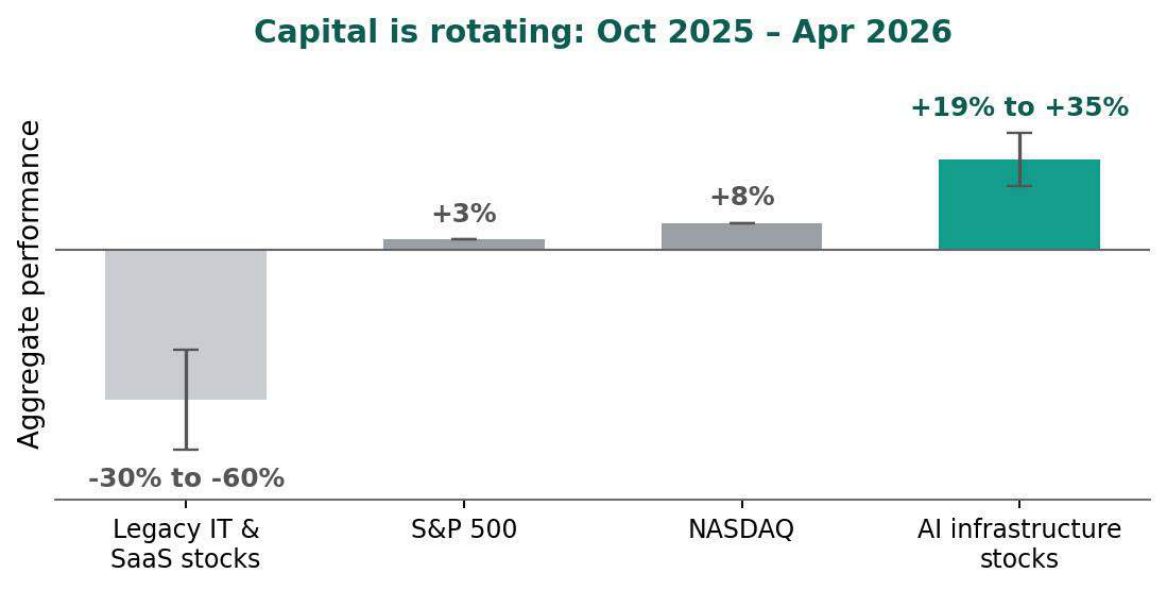
The capital markets have noticed. Between October 2025 and April 2026, legacy software and SaaS stocks fell 30–60% while AI infrastructure rose 19–35% with no structural collapse in the broader market.
“This is not macro. It is rotation — away from systems that watch, toward systems that act.”
The Next Great Leap Is Autonomy
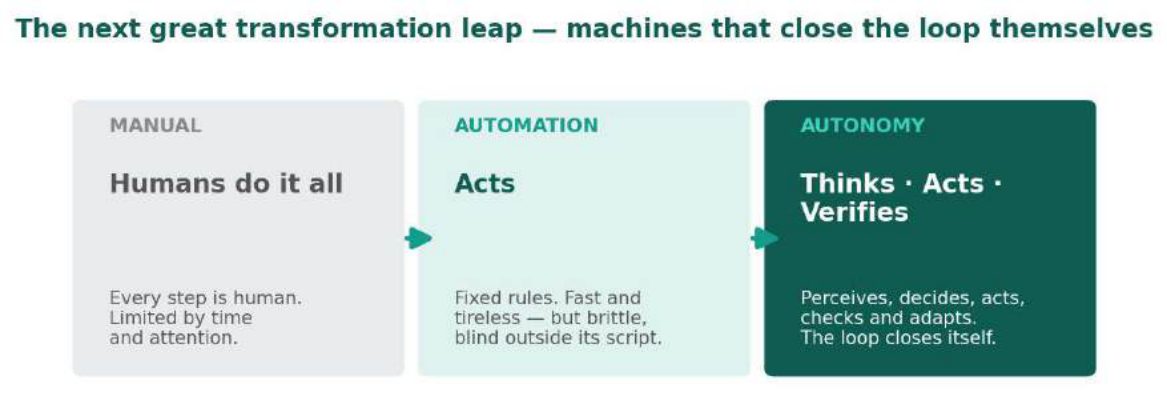
What makes this revolution different in kind is autonomy: machines that close the loop themselves - perceive, decide, act, and verify. It has become possible now because compute costs have collapsed, data is abundant, models genuinely reason, and real-time signals connect the physical world.
Architecturally, the shift runs along three dimensions: from deterministic rules to probabilistic reasoning that handles novel problems; from static scripts to reasoned runbooks that improve through feedback; and from linear scaling bottlenecked by headcount to compounding economics built on reusable intelligence.
Databases became the system of record for data. Cloud became the system of record for compute. The autonomous enterprise needs a new layer entirely, a system of autonomous execution and no incumbent was architected to become it. Gartner projects autonomous operations rising from essentially 0% of organizations today to roughly one-third by 2030. That is a new category, and its leaders have not yet been named.
Nor does autonomy stop at any one function. The same layer that transforms IT operations, the space where I spend my days, extends to sales, marketing, HR, product, finance, and operations: anywhere complexity has outpaced human capacity. The autonomous enterprise is the largest value-creation opportunity of this era. But autonomy without trust breaks adoption - autonomy compounds the gains; guardrails make them trusted, hence durable and shared.
“The goal isn’t automation. It’s trusted autonomy.”
Two Futures. We Choose Now.
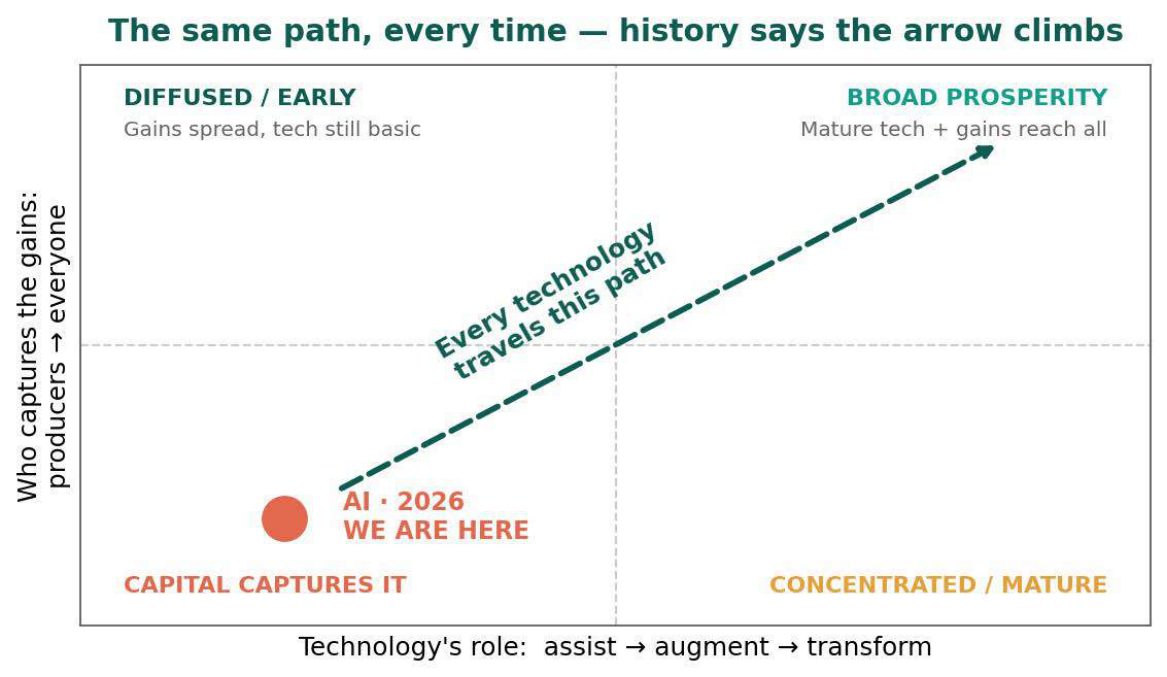
With the pain established and the technology shift underway, the choice comes into focus. Every general-purpose technology travels the same path: gains start locked up with its makers, then if the transition is managed well, climb toward broad prosperity. AI in 2026 sits at the very start of that diagonal. History says the arrow climbs. But the climb is a choice, not a law.
The fork is stark. If capital captures it all: wealth concentrates in a handful of superstar firms, wages stagnate, the educated middle hollows out, and distrust erodes the demand that returns depend on.
If labor comes along: productivity gains are shared through wages, ownership, and access; humans move up the value chain into judgment, care, and creativity; and broad demand sustains growth - returns that compound and endure.
“The technology does not decide. We do — as individuals, companies, and countries.”
Rebalancing Is a Choice. Here Is the Playbook.
For Individuals: Become Harder to Replace
Move from being a task to commanding the machine that does the task. Direct the AI, set the goal, judge the outcome, lean into what AI cannot do: care, creativity, presence. Build leverage, not just labor; one person with AI now does the work of a team. And claim a share of capital - equity, assets, upside because ownership is how workers participate in the gains.
For Companies: Augment, Then Share
Deploy AI to elevate people, not merely to cut them, human-in-command, AI-in-execution. Route gains back into wages and reskilling before you cut; productivity without shared upside buys short-term margin and long-term mistrust. And make trust the architecture: guardrails and accountability built in, not on.
For Societies and Nations: Broaden the Base
Treat reskilling as national infrastructure, with portable benefits that cushion the transition. Broaden ownership, social dividends, sovereign and worker funds so citizens share the gains of the machine. Govern for autonomy with accountability: rules that reward innovation, protect workers, and preserve human agency.
For IIT Bombay Graduates: This Transition Was Built for You
Few communities on earth are better positioned. As individuals, your careers sit exactly where the machine meets the mind, command it and you compound; compete with it and you commoditize. As builders, the greenfield is enormous: trusted autonomy, reasoning systems, and the infrastructure of the new era are precisely the first-principles problems an IIT education prepares you to attack. And as citizens of a producer-nation-in-the-making, India’s sovereign AI moment needs exactly your skills.
How Do We Drive Autonomy for Lasting, Pervasive Impact?
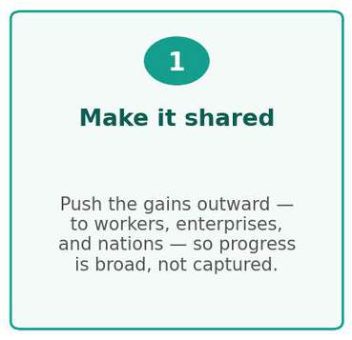
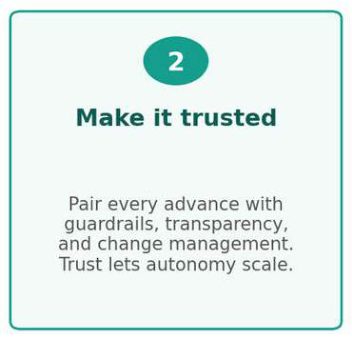
The real challenge ahead is not technology. The question isn’t who gets to be autonomous, it’s how we make autonomy reach everyone, and last. That comes down to three imperatives:
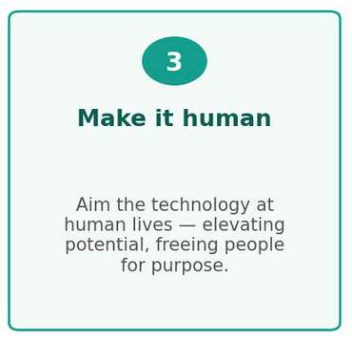
And these imperatives come with a clock. The repricing of labor is underway, the market rotation has begun, and the displacement numbers are printing the window for leaders to act is measured in quarters, not years. In a compounding technology, the gap between early movers and late ones does not stay constant. It grows.
Every Revolution’s Real Purpose Is the Same — To Make the World a Better Place
Why does any of this matter? Because the point of the machine was never the machine.
Autonomy plus empathy, that is the essence of everything worth building, and the standard against which this revolution should be judged.
The urgency is the same at every altitude. Individuals who learn to command the machine this year will out-earn those who start in five. Companies that build trusted autonomy now will own the knowledge, governance, and compounding intelligence their competitors will one day rent. Nations that secure their AI stack this decade will set terms for those that did not. The leaders who move now will lead this transition. The ones who wait will be replaced by the peers who did.
AI will create extraordinary wealth; that is no longer in question. But enduring prosperity is created only when enough people have a stake and share the gains and that outcome will be built, deliberately, by this generation of engineers, founders, and leaders.
“Waiting is itself a decision — a decision to fall behind.”
The transition is ours to manage. Let’s begin now.
“The objective of a technology revolution is a world of empathic, autonomous systems working quietly in the background — elevating human potential and freeing people to focus on innovation, progress, and purpose.”
About the author

Entrepreneur and operator, engineer and investment banker, strategist and classical musician — Shirish Nimgaonkar is an alumnus of IIT Bombay (B.Tech.), Stanford (MS), and Harvard Business School (MBA), Shirish’s career spans engineering at Intel, global investment banking as Managing Director at Alantra, and multiple exits across venture- and private-equity-backed technology companies in the US, Europe, and Asia. He has served as Entrepreneur in Residence at Harvard Business School, Board Member at TiE Boston, and is a trained classical musician and lead singer of the fusion music band - Kashish that channels music towards education and women’s empowerment. It is his conviction that leadership, at its best, is an act of creation.

Comments
Comments open soon.