Idea Watch
Gone. But Not Cured.
Antibiotics clear the urine, yet bacteria can survive inside bladder tissue. A lab-grown mini-bladder exposes hiding places that may explain why infections return.
Introduction
Urinary tract infections (UTIs) remain a major global clinical challenge. UTIs are bacterial or fungal infections that affect parts of the urinary tract, commonly starting at the bladder. The worldwide incidences of UTIs are as high as 400 million cases per annum, with over 240,000 deaths in 2019. This disease is sex-skewed in incidence, with more cases in women than in men. Approximately 60% of women will experience at least one case of UTI in their lifetime, with over 30% of women experiencing multiple bouts of infection recurrence. In symptomatic patients, UTIs are treated with antibiotics. As one of the most common cause of antibiotic prescription, UTIs play a significant role in the emerging global healthcare problem of antibiotic resistance (AMR).
The most common bacteria to cause UTIs is uropathogenic Escherichia coli, or UPEC. It accounts for 80-90% uncomplicated UTI cases. UPEC enters the body through urethra and contaminates urine. It has evolved an elaborate life cycle to exploit the tissue. These bacteria attach themselves to urothelium (umbrella cells) via type 1 pili and invades to form intracellular bacterial communities that shields it from antibiotics and immune cells. This allows them to persist for long times in quiescent intracellular reservoirs deep in the tissue, which re-emerge and cause recurrent infections. This infection causes inflammation and irritation, quite commonly associated with UTI.
Why organoids matter
The bladder is a complex organ that co-exists with urine, the toxic waste product of the body, which in itself is constantly changing in compositions, based on hydration diet, and disease. The bladder epithelium or urothelium is not a passive container. It is a highly specialized multi-layered barrier that withstands continuous exposure to urine of variable and sometimes toxic composition. Although stable under healthy conditions, more concentrated the urine, more damaging and irritable it can be to the bladder tissue.
Traditional tools for studying this process have real limitations. Two dimensional cell culture lacks the stratified architecture of real urothelium. Whereas mouse models capture whole -organism physiology and immune processes but allows tissue pathology to be assessed as end point snapshots. Also, rodent models do not always recapitulate human scenarios where there is huge variability in urine composition depending on hydration status, diet, medications and health. Organoids and microphysiological bladder models have been developed and are successful in bridging this gap.
A New “Mini-Bladder” Model
A mini-bladder on a chip shows how infections hide from antibiotics
Meet the mini-bladder
Bacteria dig in
Researchers grew living human bladder tissue inside a lab chip, filled it with urine, and watched infections unfold hour by hour
Strong urine weakens it
Shape-shifters survive
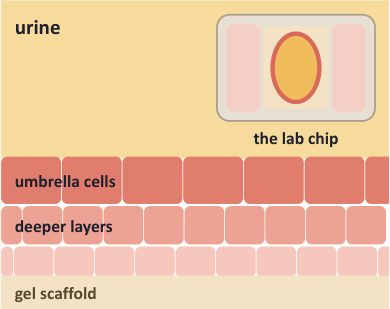
Our lab has tried to combine a stratified urothelium, a perfusable lumen for urine flow and micturition and the capacity for a tissue to stretch in one platform to develop a human lab-grown ‘mini-bladder’, that mimics the bladder epithelium’s complex architecture. The device is engineered to hold a hydrogel block, in which layered structure of the lining of the human bladder is recreated by growing primary epithelial cells into fully stratified, polarized tissue with perfusable lumen. This tissue is exposed to urine and mimics filling and emptying cycles by mechanical stretching controlled by hydraulic pressure across the device, to simulate the condition inside the body.
Urine Composition shapes tissue resilience
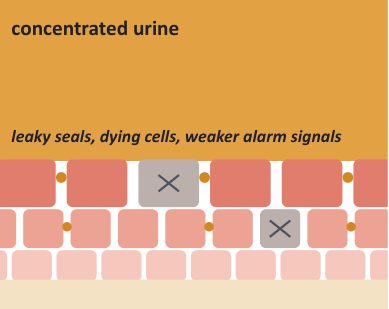
This model allowed us to study how the chemical composition of the urine shapes resilience of the bladder to the infection and its response to the antibiotics. Using this model, we observed that urine can impact the health of the bladder. After perfusing the mini-bladder with urine of different but defined compositions, we observed that concentrated urine with high solute concentration compromised barrier integrity, downregulated tight junctions, suppressed immune signalling and reduced bladder’s resilience. This was also consequential under infection. We observed that infecting the tissue that is pre-exposed to concentrated urine accumulated a larger burden of tissue associated UPEC as a consequence of easier bacterial access to deeper epithelial layers due to compromised barrier integrity.
Impact on Antibiotic Treatment
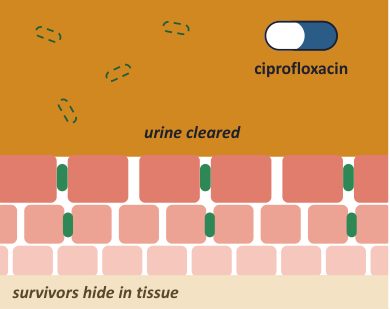
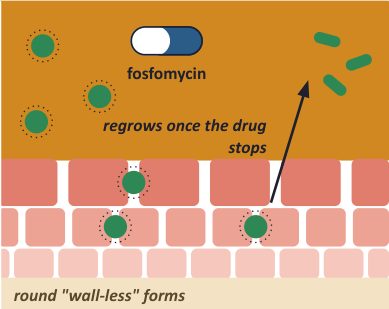
The most clinically relevant finding was the effect on antibiotic efficacy which is commonly used to treat UTI. Two antibiotics with different mechanisms of action were tested. Tissue associated bacteria were harder to clear with ciprofloxacin under high solute urine conditions than under low solute conditions, even though drugs efficiently cleared bacteria from the urine. For another antibiotic fosfomycin, a first line, single dose therapy for uncomplicated UTIs, interestingly, protective effect of high solute urine extended to the luminal bacterial populations and resulted in faster bacterial regrowth after treatment. These observations suggested that co-morbidities that alter urine composition can have a detrimental synergistic effect in infection and generate favourable conditions for a relapse of infection.
Cell Wall Deficient UPEC
When we investigated further into why tissue associated bacteria are harder to clear, we discovered a surprising phenomenon. Fosfomycin under high solute urine conditions generates large, spherical, cell wall deficient UPEC in both urine and embedded within tissue. The formation of these cell wall deficient bacteria lodged between the cells in deeper layers drives recurrence after antibiotic treatment We are the first to show that cell wall deficient UPEC can exist within the tissue and contribute to infection recurrence, even if the bacteria in urine is cleared.
Implications for UTI
We have developed a unique platform for detailed exploration of the tripartite interaction between urine composition, the urothelium, and UPEC. This model allows to study interplay between host tissue, urine and pathogen. Such a model is not only useful to understand host-pathogen interactions but also rationally design therapeutic strategies for UTI. Such a model can help us answer scientific questions which two dimensional cell cultures or rodent models are unable to. Our findings using mini-bladder underscored the importance of urine composition as an active variable in bladder infections, which is often overlooked. The patients prone to concentrated urine through dehydration, impaired renal function, catheterisation or any other form of urinary stasis could be at increased risk of having a larger pool of tissue resident bacteria making them more vulnerable to antibiotic treatments. Recurrent UTI is very difficult to treat. Hopefully, our model will help advance the bladder research towards better therapeutics.
Why infections return
Hidden wall-less bacteria are a new suspect in repeat UTIs.
Smarter drug testing
Antibiotics could be tested in urine that matches real patients.
Urine chemistry counts
Dehydration, kidney disease or catheters may raise infection risk.
What comes next
Adding blood vessels and immune cells to the mini-bladder.
About the author

Gauri Paduthol — IIT Bombay, Mechanical Engineering dual degree, Class of 2019. Researcher whose doctoral work at EPFL investigates human mini-bladder models and recurrent urinary-tract infections.


Comments
Comments open soon.